I saw this video over the weekend. Going to watch it again, join me:

Wednesday, September 07, 2011


Fort Wayne Site of the Day-Trolley Tour

September 22nd is the date for the annual Fort Wayne Museum of Art Trolley Tour.
Every day leading up to the event, I am featuring an organization associated with this years tour.
Get details by going here, and to visit today's site click on pic.
Tuesday, September 06, 2011
Labor for Yourself?
Over the past 25+ years I have spoken with hundreds of business owners.
Many had the urge to be their own boss and took the plunge.
I've seen too many fail because they didn't plan properly.
Harvey shared some advice this summer:
By Harvey Mackay
I have never met anyone who left his or her job, whether fired or voluntarily, who started his or her own business -- and regretted it. What these people always regret is not having done it sooner. This includes people who eventually failed and had to go back to work for someone else.
Afraid to try something new? Most of us are. But our regrets will invariably be for what we didn't do rather than for what we did.
So are you ready to be an entrepreneur? Do you have the right stuff? Before you take the plunge and start your own business, take this test:
Do you need a new idea? It isn't the quality of the ideas you have that will determine whether you are successful, it's the qualities you bring to those ideas. New ideas are wonderful if you can come up with them. But your best chance of success is working hard, using established values and ideas if necessary.
Who are your customers? "Everyone" is the wrong answer. If your concept is going to succeed, you have to identify a realistic target audience, big enough to be profitable yet small enough for you to service it thoroughly.
Why should anyone want to buy your product or service? Find an unmet, unanswered need by identifying a market segment that isn't being served or is being served inadequately. For example, take the post office which served everybody, but unprofitably. Then FedEx and UPS jumped in and redefined the industry. They are profitable, while the post office is bleeding red ink.
Who is your competition? If there is a market for your product or service, someone is supplying that market. He may be using another product. Or she may be using a nearly identical product that you can beat on quality, performance or service. Either way, the existence of competition is a mixed blessing. It doesn't really matter how many others are doing something similar. All you have to do is find a way to do it better.
What advantages does your organization have over the competition? Management? People? Product? Service? Financial strength? Reputation? Recognition? Marketing? One is not enough. Sometimes all are not enough. But you can usually beat better-financed competition with superior customer advantages.
Do you have a business plan? If you haven't gotten around to that, make one before you do anything else. It serves several very useful purposes. It forces you to think your way through the startup process and your long-range goals. It's also a document you'll need if you plan on getting outside financing from anyone except your relatives. If it isn't persuasive and effective to an independent outside businessperson, that might tell you something about your real chances for success. Your plan should include a situation analysis; objectives; target audiences; mission statement; objective; strategy and tactics; execution; budget; measurement; and time and action calendar.
What do your banker and lawyer say? Bankers see and evaluate business plans all day long. That's their business. They might even have seen one like yours. And while you're at it, ask if they would lend you money to finance your business. Attorneys can help you avoid pitfalls. They are there to protect you.
What does your mentor say? Find a "tiger," preferably someone who's been around the block. Retired professionals are a marvelous resource for this kind of advice. I can't urge you enough to check out SCORE. They have access to people with every imaginable kind of business experience. They also have the time, patience, skill, wisdom and understanding to help and sometimes, just to listen. They are invaluable at helping you expand your network of contacts.
Have you done an honest self-survey? Do you really want to do this or are you just trying to escape your own problems? Be brutally honest and make sure the problem is not you. If you're going to be an entrepreneur, you have to believe in yourself more than you believe in anything else in the world.
What will you do if you fail? Don't be discouraged if you do fail. Few entrepreneurs make it the first time they try. Failure teaches you not to fear failure because if you can survive it to fight again, you haven't failed. You have only heightened your appreciation of success.
Mackay's Moral: If you're looking for a big opportunity, look for a big challenge.
Many had the urge to be their own boss and took the plunge.
I've seen too many fail because they didn't plan properly.
Harvey shared some advice this summer:
Before you start your own business, take this entrepreneur test
By Harvey Mackay
I have never met anyone who left his or her job, whether fired or voluntarily, who started his or her own business -- and regretted it. What these people always regret is not having done it sooner. This includes people who eventually failed and had to go back to work for someone else.
Afraid to try something new? Most of us are. But our regrets will invariably be for what we didn't do rather than for what we did.
So are you ready to be an entrepreneur? Do you have the right stuff? Before you take the plunge and start your own business, take this test:
Do you need a new idea? It isn't the quality of the ideas you have that will determine whether you are successful, it's the qualities you bring to those ideas. New ideas are wonderful if you can come up with them. But your best chance of success is working hard, using established values and ideas if necessary.
Who are your customers? "Everyone" is the wrong answer. If your concept is going to succeed, you have to identify a realistic target audience, big enough to be profitable yet small enough for you to service it thoroughly.
Why should anyone want to buy your product or service? Find an unmet, unanswered need by identifying a market segment that isn't being served or is being served inadequately. For example, take the post office which served everybody, but unprofitably. Then FedEx and UPS jumped in and redefined the industry. They are profitable, while the post office is bleeding red ink.
Who is your competition? If there is a market for your product or service, someone is supplying that market. He may be using another product. Or she may be using a nearly identical product that you can beat on quality, performance or service. Either way, the existence of competition is a mixed blessing. It doesn't really matter how many others are doing something similar. All you have to do is find a way to do it better.
What advantages does your organization have over the competition? Management? People? Product? Service? Financial strength? Reputation? Recognition? Marketing? One is not enough. Sometimes all are not enough. But you can usually beat better-financed competition with superior customer advantages.
Do you have a business plan? If you haven't gotten around to that, make one before you do anything else. It serves several very useful purposes. It forces you to think your way through the startup process and your long-range goals. It's also a document you'll need if you plan on getting outside financing from anyone except your relatives. If it isn't persuasive and effective to an independent outside businessperson, that might tell you something about your real chances for success. Your plan should include a situation analysis; objectives; target audiences; mission statement; objective; strategy and tactics; execution; budget; measurement; and time and action calendar.
What do your banker and lawyer say? Bankers see and evaluate business plans all day long. That's their business. They might even have seen one like yours. And while you're at it, ask if they would lend you money to finance your business. Attorneys can help you avoid pitfalls. They are there to protect you.
What does your mentor say? Find a "tiger," preferably someone who's been around the block. Retired professionals are a marvelous resource for this kind of advice. I can't urge you enough to check out SCORE. They have access to people with every imaginable kind of business experience. They also have the time, patience, skill, wisdom and understanding to help and sometimes, just to listen. They are invaluable at helping you expand your network of contacts.
Have you done an honest self-survey? Do you really want to do this or are you just trying to escape your own problems? Be brutally honest and make sure the problem is not you. If you're going to be an entrepreneur, you have to believe in yourself more than you believe in anything else in the world.
What will you do if you fail? Don't be discouraged if you do fail. Few entrepreneurs make it the first time they try. Failure teaches you not to fear failure because if you can survive it to fight again, you haven't failed. You have only heightened your appreciation of success.
Mackay's Moral: If you're looking for a big opportunity, look for a big challenge.
Fort Wayne Site of the Day-Trolley Tour

September 22nd is the date for the annual Fort Wayne Museum of Art Trolley Tour.
Every day leading up to the event, I am featuring an organization associated with this years tour.
Get details by going here, and to visit today's site click on pic.
Monday, September 05, 2011
Ending & Keeping Relationships
At this very moment, I am wrapping up a family Labor day gathering.
The details have caused some folks to give me a few curious looks when I shared with them what I would be doing today.
The family party is at my ex-wife's in-laws.
Karen and I divorced in 1995 after 13 years and 3 kids.
It was those three kids that kept us in a relationship.
A different relationship than husband and wife to be sure.
And each of us have remarried and are very much in love with our new spouses.
But we decided to maintain a civil relationship as parents.
I admit we've had our battles over the past 15 years, but we work thru them eventually.
And we have been thru a lot with weddings, college graduations, and now grandkids.
Maybe it helps that we live in separate cities, about an hour apart. Far enough apart to prevent the causal bumping into one another, but close enough to make contact when needed.
One of the reasons Karen and her husband Steve invited my wife Kathy and I over was the gathering of all of our kids and their spouses.
We've had a few in the past several months including holidays and a couple weddings but those were filled with the busy-ness of those events and today is a much more relaxed gathering without any extra agendas.
The relationship dynamics between former spouses can be tricky, and I am blessed to have a wife Kathy who is also a believer in creating new relationships out of broken ones when it is appropriate as I am also friends with her ex-husband and his family.
One of the keys to this is how you end the relationship and with some tips, here's a story from AOM:
Dim & Dash: Breaking Up
The details have caused some folks to give me a few curious looks when I shared with them what I would be doing today.
The family party is at my ex-wife's in-laws.
Karen and I divorced in 1995 after 13 years and 3 kids.
It was those three kids that kept us in a relationship.
A different relationship than husband and wife to be sure.
And each of us have remarried and are very much in love with our new spouses.
But we decided to maintain a civil relationship as parents.
I admit we've had our battles over the past 15 years, but we work thru them eventually.
And we have been thru a lot with weddings, college graduations, and now grandkids.
Maybe it helps that we live in separate cities, about an hour apart. Far enough apart to prevent the causal bumping into one another, but close enough to make contact when needed.
One of the reasons Karen and her husband Steve invited my wife Kathy and I over was the gathering of all of our kids and their spouses.
We've had a few in the past several months including holidays and a couple weddings but those were filled with the busy-ness of those events and today is a much more relaxed gathering without any extra agendas.
The relationship dynamics between former spouses can be tricky, and I am blessed to have a wife Kathy who is also a believer in creating new relationships out of broken ones when it is appropriate as I am also friends with her ex-husband and his family.
One of the keys to this is how you end the relationship and with some tips, here's a story from AOM:
Dim & Dash: Breaking Up
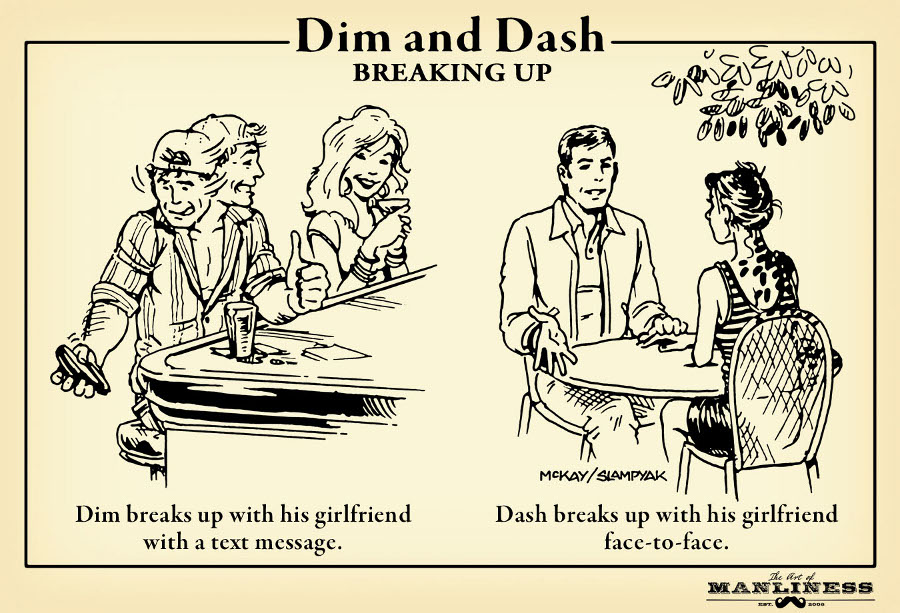
When you were a kid, did you ever read the comic “Goofus and Gallant” in Highlights Magazine? Goofus and Gallant were two boys with very different attitudes and temperaments. The comic would show how each boy would respond in the same situation–Goofus always did the wrong thing, while Gallant always did the right thing. What would those boys be like as grown men? We’ve decided to imagine in a new twice-monthly comic series called “Dim and Dash.” Drawn by Ted Slampyak, the comic will be a fun way to present quick reminders on the right way for a man to act. Hope you enjoy!
Fort Wayne Site of the Day-Trolley Tour

September 22nd is the date for the annual Fort Wayne Museum of Art Trolley Tour.
Every day leading up to the event, I am featuring an organization associated with this years tour.
Get details by going here, and to visit today's site click on pic.
Sunday, September 04, 2011
Saying Thanks

Good Stuff from Harvey:
2, 4, 6, 8 - Who do you appreciate?
By Harvey Mackay
 A university professor began reflecting on the people who had a positive impact on his life. In particular he remembered a schoolteacher who had gone out of her way to instill in him a love of poetry. He hadn't seen or spoken to her in many years, but he located her address and sent her a letter of thanks. A short time later, he received this reply:
"My dear Willie, I cannot tell you how much your note meant to me. I am in my eighties, living alone in a small room, cooking my own meals, lonely, and, like the last leaf of autumn, lingering behind. You will be interested to know that I taught school for 50 years and yours is the first note of appreciation I ever received. It came on a blue-cold morning, and it cheered me as nothing has in many years."
The teacher's note brought the professor to tears -- and then he began searching for others who'd shaped his life, just to say thanks.
If only more people held onto gratitude the way they hold a grudge!
None of us got to where we are alone. Whether the assistance we received was obvious or subtle, acknowledging someone's help is a big part of understanding the importance of saying thank you.
It's more than just good manners. Saying thank you -- and meaning it -- is never a bad idea. It appeals to a basic human need to be appreciated. It sets the stage for the next pleasant encounter. And it helps keep in perspective the importance of receiving and giving help.
Retailing giant Sam Walton wrote ten rules for success, and the Walmart founder didn't mince words when it came to being thankful. The fifth of Walton's rules is "Appreciate everything your associates do for the business."
I wish I could convince every business owner and manager to adopt that attitude. If you have hired well and provided the necessary tools that allow your staff to perform their jobs, and they have achieved accordingly, the next logical step is acknowledgment of their efforts.
The cost of praising someone is nil -- but a recent study has found that the payoff can be huge. Employees want to be seen as competent, hardworking members of the team. Good managers want satisfied, motivated, and productive staff members. What better motivator than thanking employees for their contributions to the company's success?
A Personnel Today survey of 350 human resources professionals found that the greatest factor in workplace productivity is a positive environment in which employees feel appreciated. According to the survey, two-thirds of the respondents said they felt a lot more productive when they received recognition for their work, while the remainder said they felt a little more productive.
Just feeling productive can be motivating in itself. When workers don't feel productive, frustration sets in, according to 84 percent of the survey respondents. Here's a startling result: 20 percent said they felt angry or depressed when they weren't able to work as hard as they could.
How to best praise effectively? Try these ideas.
- Be sincere. Give praise only where it is due.
- Give public praise. The goal is to encourage employees to keep up the good work, while simultaneously encouraging others to put out greater effort. Praising in public raises general morale.
- Be specific in your praise. Identify exactly what the employee worked on and what he or she accomplished. Don't just say, "Well done, Maggie." If the employee feels the praise isn't genuine, it could have a negative effect.
- Provide some lasting recognition. Consider a letter in the employee's file or a simple celebration for the department that overcame a tough challenge. Appreciation is not a one-shot event. It needs to be ongoing.
All links along the chain are essential to your success. It's so easy to ignore the person who delivers office supplies, the tech who unfroze your computer, or the customer who referred you to a great new account. Big mistake. They all deserve acknowledgment, especially if you want to preserve the relationship.
And while you're at it, don't forget your favorite teacher.
Mackay's Moral: An attitude of gratitude should have wide latitude.
Fort Wayne Site of the Day-Trolley Tour

September 22nd is the date for the annual Fort Wayne Museum of Art Trolley Tour.
Every day leading up to the event, I am featuring an organization associated with this years tour.
Get details by going here, and to visit today's site click on pic.
Saturday, September 03, 2011
Fort Wayne Site of the Day-Trolley Tour

September 22nd is the date for the annual Fort Wayne Museum of Art Trolley Tour.
Every day leading up to the event, I am featuring an organization associated with this years tour.
Get details by going here, and to visit today's site click on pic.
Friday, September 02, 2011
Another Reason to Blog

My daughter Rachael used to keep a journal.
Lots of them.
She's a writer.
She introduced me to the world of blogging back in 2003 or 4.
I decided last night to take a trip down memory lane and see what I was doing 5 years ago.
I recorded it right here on this blog.
Have you started blogging yet?
Fort Wayne Site of the Day-Trolley Tour

September 22nd is the date for the annual Fort Wayne Museum of Art Trolley Tour.
Every day leading up to the event, I am featuring an organization associated with this years tour.
Get details by going here, and to visit today's site click on pic.
Thursday, September 01, 2011
Can I have your Attention?
All of us could do a better job of listening.
Here's a few tips on being less of a jerk.
From DLM:

When people speak, do you listen? How much of what's communicated do you internalize?
Recently, I was talking to someone who was not very present in the conversation. Even though she would nod and say "Yeah" the whole time we communicated, her follow-up comments would reveal she wasn't listening 100%.
For example, there was a point when I talking about A, but she kept replying to me as if I was saying B. I thought it was really strange, so I repeated what I said in a slower, more precise manner. But the same thing happened - while she would nod and say "Yeah" while I was speaking, her reply suggested she did not get the gist of what I was trying to say.
At that point, I was entirely baffled. After engaging in a few more conversations with her, I realized it was a norm with her. She often nodded and looked like she was following the conversation, but her comments were often off tangent. It would seem that even though she exhibited "signs" that she was listening, she was never really listening.
Listening is an important skill - more so than one may realize. We use it all the time - at work with our managers and co-workers, in presentations, in relationships, in social settings, with our families. Believe it or not, we even use it when watching TV and films!
In my work, listening is especially important. When I'm coaching my clients, it's important I listen and understand their underlying problems (that may even elude them), so I could ask the appropriate coaching questions to forward them. When I'm communicating with the readers at my blog, it's important I read between the lines and "listen" to what they're trying to say, because words alone may not convey their intended messages.
I've learned that being a good listener takes more than just hearing what the person has to say - it requires conscious desire, conscientiousness, and practice. In this article, I share my 7 personal tips on how to be a better listener:
Here's a few tips on being less of a jerk.
From DLM:
7 Powerful Tips To Becoming a Better Listener
Posted: 22 Aug 2011 08:18 AM PDT
When people speak, do you listen? How much of what's communicated do you internalize?
Recently, I was talking to someone who was not very present in the conversation. Even though she would nod and say "Yeah" the whole time we communicated, her follow-up comments would reveal she wasn't listening 100%.
For example, there was a point when I talking about A, but she kept replying to me as if I was saying B. I thought it was really strange, so I repeated what I said in a slower, more precise manner. But the same thing happened - while she would nod and say "Yeah" while I was speaking, her reply suggested she did not get the gist of what I was trying to say.
At that point, I was entirely baffled. After engaging in a few more conversations with her, I realized it was a norm with her. She often nodded and looked like she was following the conversation, but her comments were often off tangent. It would seem that even though she exhibited "signs" that she was listening, she was never really listening.
Listening is an important skill - more so than one may realize. We use it all the time - at work with our managers and co-workers, in presentations, in relationships, in social settings, with our families. Believe it or not, we even use it when watching TV and films!
In my work, listening is especially important. When I'm coaching my clients, it's important I listen and understand their underlying problems (that may even elude them), so I could ask the appropriate coaching questions to forward them. When I'm communicating with the readers at my blog, it's important I read between the lines and "listen" to what they're trying to say, because words alone may not convey their intended messages.
I've learned that being a good listener takes more than just hearing what the person has to say - it requires conscious desire, conscientiousness, and practice. In this article, I share my 7 personal tips on how to be a better listener:
- Remove All Distractions
In this day and age, in our quest to get as much done as we can, we multi-task the whole time - from web browsing, checking emails, replying emails, working, talking on the phone, fiddling with our phones, writing in our notebooks, etc. So when people approach us to talk, it's natural we add that to the list of things we're doing at the moment, vs. giving them our full attention.
To be honest, I do this myself, especially if it's just a short or casual conversation. I think it's fine if you're able to attend to the other party's request. However, if the person is trying to tell you something important, or share something personal, you should ideally stop what you are doing and give him/her your full attention. What I do is I close the lid of my laptop (hence eliminating all distractions), turn myself towards the person and give him/her my full focus. Doing so is a sign of respecting him/her. - Be Present
Are you present when you're around other people? Or are you lost in your own thoughts?
In the example I shared in the opening, it was apparent my friend was not present during the conversations. Even though she would nod as a sign of acknowledgement while others were speaking, her mind was lost in her thoughts. Hence, when it was her turn to speak, her comments would be off tangent to what was being communicated.
To be a good listener, you have to be present. Being present means (a) not being preoccupied physically (b) not being preoccupied mentally. The former means to remove distractions, as I mentioned in Tip #1. The latter requires you to clear your mind of other thoughts and focus on the person speaking. This means to stop thinking about the argument you had at work with your co-worker in the morning, the report you've yet to finish, or where you're going to have your dinner, and to pay attention to what's being communicated now.
How does one become more present? I see it as an ongoing path, rather than one end goal. One activity that never fails me is this 15 minute brain dumping exercise, whereby I clear out mental clutter instantly. Meditation is another useful habit that helps me to be more present - instead of thinking about the past or the future, I'll be in the current moment, which is the moment we are living in anyway. - Wait for the Person to Finish Speaking (in the start)
It's good etiquette to let the other party finish what he/she wants to say, before you butt in with your comments. I know there are times you feel you get what the person is trying to say and you can't wait to share your comments, but hold it off in the beginning of the conversation. Because the person may have other things to share but can't because you are speaking.
I find that often times when I just sit and wait, the person will often have something to add on - which I would never have known if I had interjected or stepped in to speak. Once I get a hang of what the person has to say and where the person is coming from, I'll be more open in interjecting, while being conscious of the person's needs and letting him/her go ahead if there's anything he/she wants to say. - Don't Assume Anything
An important part of listening is not to assume. When you assume, you automatically layer over what the person says with your presumptions, which makes it near impossible to have any meaningful conversation. While the person may say A, ultimately you can only hear B, simply because your mind is not open to receiving new information in the first place.
When it comes to communication, err on the side of safety and assume you know nothing. In this regard, questions are your best friends (see #7). - Look at the Sub-Text
Powerful listening requires you to understand that the words articulated in a conversation do not always represent the person's intentions. Many times, we are not 100% clear about what we're trying to say, and talking is really our way of processing our thoughts.
In this regard, don't rely too much on the words communicated, per se. Instead, look at the sub-text - such as the facial expressions of the person, the tone of the voice, the body language, the choice of words, and so on. What is the person trying to say? What do you think he/she is feeling? What is he/she thinking behind his/her words? Combine this with what he/she is saying to you and you'll get a lot more out of the conversation. - Clarify to ensure you got what the person is saying
At every stage of the conversation, clarify to ensure you got the message right. This can be done by simply paraphrasing what he/she just said, in your own words. Sometimes we may take away one message when it's really something else, and it's not good to assume without clarifying first (see #4).
What I do is I'd interject every now and then and make 1-2 clarifying statements, such as "Ok, so what you're saying is that ..........., right?", in which the person simply needs to say "Yes" or "No". This helps ensure everyone is on the same page before any more new information is shared. - Ask Questions
Questions are highly important in any conversation. Firstly, there are things which the person does not share (either because he/she thinks you already know them or because he/she thinks they are irrelevant) that you can only uncover by asking questions. Secondly, questions lets you get more information about specific areas you are unclear about, such that you get a better picture of what the person is saying.
My conversing style involves a lot of questions, especially at the beginning of the conversation. This is because because I see this as the "understanding" or "information gathering" phase. Rather than overshare at the start, I prefer to understand the person and get a good grasp of who he/she is, then share my point of view. This has worked very well in my communications with others, as others quickly ease into their natural persona and open up about what they want to talk about. Because of this, it has allowed me to easily connect with others and develop meaningful relationships - which is what we want to achieve at the end of the day.
- 10 Keys To Becoming a Better Communicator
- 5 Key Steps To Handle Rejection Like a Pro
- 8 Simple Steps To Overcome Shyness
- 7 Ways To Instantly Meet Like-Minded People
- 9 Useful Strategies To Dealing with Difficult People at Work
- 10 Ways To Earn the Respect of Others
 | Written on 8/22/2011 by Celestine Chua. Celestine writes at The Personal Excellence Blog, where she shares her best advice on how to achieve personal excellence and live your best life. Get her RSS feed directly and add her on Twitter @celestinechua. If you like this article, you will enjoy one of her top articles: 101 Things To Do Before You Die. | Photo Credit: Ed Yourdon |
Fort Wayne Site of the Day-Trolley Tour

September 22nd is the date for the annual Fort Wayne Museum of Art Trolley Tour.
Every day leading up to the event, I am featuring an organization associated with this years tour.
Get details by going here, and to visit today's site click on pic.
Subscribe to:
Posts (Atom)